
Wondering which digital product discovery platforms are right for your building products? It’s not always easy to tell which ones will truly help you get your products seen and specified by the right AEC (Architecture, Engineering, and Construction) professionals. But it’s also important to remember that the strongest approach is rarely choosing just one—in fact, most manufacturers see the best results when they maintain a presence across multiple platforms.
In this guide, we break down the pros and cons of the leading online product discovery platforms so you can make an informed decision about which ones you want to trust with your products.
- Acelab Material Hub
- ARCAT
- Architizer
- BIM&CO
- BIMobject
- BIMsmith
- BIMstore
- Lattira
- Material Bank
- Modlar
- Sweets
- CADdetails
Acelab Material Hub
Acelab Material Hub is a newer-generation digital specification platform focused on modern UX and streamlined product discovery. Founded in 2019, the platform focuses on clean user experience, structured product data, and intuitive search tools that reflect a larger shift toward digital-first, research-driven workflows.
Pros
- Clean, modern interface with AI-powered search and side-by-side product comparisons
- Specifiers can connect directly with manufacturers through the platform to ask questions, get clarification, and build relationships
- Enhanced analytics to track engagement and marketing services to improve product visibility
Cons
- Smaller market presence and lower brand recognition compared to long-established platforms
- Does not offer services for creating or optimizing design content like CAD drawings, BIM models, 3D models, or specifications
- No integrations with PIM (Product Information Management), DAM (Digital Asset Management), or CRM (Customer Relationship Management) tools
Pricing: Plan-based, learn more here.
Architizer
Founded in 2009, Architizer is a global architecture platform that connects AEC professionals with building product manufacturers through a combination of product listings, editorial content, awards programs, and marketing opportunities. While Architizer includes a product discovery component through Architizer Product Catalog, the platform primarily focuses on brand visibility, design inspiration, and marketing exposure rather than technical specification workflows.
Pros:
- Large global audience of AEC professionals with strong industry recognition and credibility
- Opportunities for sponsored content, product promotion, and advertising to increase brand visibility
- Visually rich platform that highlights design inspiration and architectural projects
Cons:
- Primarily focused on product marketing and design inspiration
- Does not directly host downloadable design files such as CAD drawings, BIM models, or specifications
- Analytics provide limited visibility into specification intent compared to other platforms
Pricing: Need to contact sales.
ARCAT
Known primarily for its extensive product library and document-focused approach, ARCAT is one of the most established platforms in the industry. Founded in 1991, its long-standing presence in the market has made it a go-to resource for design teams seeking reliable, specification-ready content to streamline project planning.
Pros:
- Strong brand recognition with a large network of registered AEC professionals
- AEC users can view and download files without needing to create an account, reducing friction for product discovery
- Offers services for creating or optimizing design content like CAD drawings, BIM models, 3D models, or specifications
Cons:
- Limited visibility into engagement metrics, making it difficult to track AEC interest or content performance
- The interface can feel dated, and the large volume of design files make it harder for your products to stand out
- Limited ability to engage and nurture prospects compared to other platforms
Pricing: Need to contact sales.
BIM&CO
BIM&CO is a BIM content management and distribution platform that helps manufacturers create, host, and share high-quality BIM objects with the AEC community. Founded in 2015, it emphasizes data standardization, object quality, and interoperability across software platforms, enabling manufacturers to centralize their content while providing specifiers with reliable, workflow-ready BIM objects.
Pros:
- Strong capabilities for hosting and developing BIM content
- Centralized content management through Onfab and Onfly
- Robust analytics for tracking file downloads and engagement
Cons:
- Heavily focused on BIM content, with less emphasis on CAD drawings, 3D models, and specifications
- Limited marketing opportunities, with no expanded advertising services or paid placement options
- Lower brand recognition among AEC professionals outside BIM-focused workflows and compared to long-established platforms
Pricing: Need to contact sales.
BIMobject
Founded in 2011, BIMobject is a BIM-focused content marketplace that connects manufacturers with a broad community of design professionals. Their data-driven tools transform downloads into decisions, helping you understand your true market position.
Pros:
- Robust analytics supported by a large global AEC user base
- Built-in email tool to nurture and engage prospects, and marketing tools to strengthen brand presence within the platform
- BIMobject's APIs allow manufacturers to embed BIM content directly into their own websites, and to access product metadata from the BIMobject catalog
Cons:
- Heavily focused on BIM content, with less emphasis on CAD drawings, 3D models, and specifications
- Premium visibility and marketing features may require additional investment
- BIMobject’s global approach can make it harder for AEC professionals to ensure compliance with local standards
Pricing: Plan-based, learn more here.
BIMsmith
BIMsmith is a BIM-centric platform designed to support modern, research-driven product selection. As a newer entrant to the AEC space, it offers a range of helpful integrations and tools that support research and specification directly within modeling environments.
Pros:
- Broad ecosystem of integrations, including UL, UNIFI, HPD Collaborative, and Swatchbox
- Clean, modern interface that supports intuitive and efficient product research
- Built-in side-by-side product comparison tools that make evaluation easier for specifiers
Cons:
- Smaller AEC audience compared to long-established platforms
- Heavily focused on BIM content, with less emphasis on CAD drawings, 3D models, and specifications
- Few options for manufacturers to increase visibility, with no paid placement or promotional features available
Pricing: Need to contact sales.
Bimstore
Bimstore emphasizes well-developed BIM content, design-ready assets, and strong usability within architectural workflows. It also offers BIM content development services, helping manufacturers ensure their products are accurately represented and easy for designers to use during the design process.
Pros:
- Supports immersive VR and AR experiences for interactive product demonstrations
- Integrates with Sinc, a PIM platform that supports better product management
- Provides BIM content development services to create accurate and specification-ready digital objects
Cons:
- Heavily focused on BIM content, with less emphasis on CAD drawings, 3D models, and specifications
- Smaller platform audience compared to some long-established platforms
- Lower brand recognition in the North American AEC markets compared to other platforms
Pricing: Plan-based starting at $455/month, learn more here.
Lattira
Lattira is a newly launched platform designed to support curated product listings, structured product data, and seamless integration into specification workflows. It includes integrated specification writing software with built-in spec content for both U.S. and international markets, helping specifiers research, evaluate, and select products more efficiently during the design phase of a project.
Pros:
- Products appear directly within specification workflows, with updates automatically syncing across projects where you’ve been specified
- Built-in analytics dashboard allows manufacturers to track views, downloads, and specification activity
- Integrates with product data management tools through the NBS Chorus and NBS Source ecosystem
Cons:
- Newer platform with limited market adoption and brand recognition compared to long-established platforms
- Limited historical data, making it harder to benchmark AEC engagement and performance over time
- Does not provide services for creating or optimizing design content such as CAD drawings, BIM models, 3D models, or specifications
Pricing: Need to contact sales.
Material Bank
Material Bank is a material discovery platform that connects building product manufacturers with AEC professionals through a centralized digital marketplace and overnight sample delivery service. Founded in 2019, the platform focuses heavily on physical material sampling, allowing design professionals to explore and request samples during the design process.
Pros:
- Provides high-intent leads from design professionals actively evaluating materials
- Overnight sample delivery through FedEx Priority Overnight for fast turnaround
- Sample reclamation program that encourages reuse, helping maximize materials and reduce landfill waste
Cons:
- Focuses primarily on physical material samples rather than digital design files
- Smaller amount of registered AEC users compared to other platforms
- Not suitable for manufacturers who don’t offer physical samples
Pricing: Need to contact sales.
Modlar
Founded in 2014, Modlar combines a searchable product library with editorial content, project inspiration, and assets to help specifiers discover products during the early design phase. The platform focuses on visual discovery and design inspiration, positioning itself as both a product directory and a resource for architectural ideas and project planning.
Pros:
- Intuitive interface with a strong emphasis on visual product discovery and design inspiration
- Combines product listings with editorial features and project content, giving manufacturers additional opportunities for exposure
- Provides insightful engagement analytics, including product views and file downloads
Cons:
- Smaller AEC audience compared to long-established platforms
- Limited integrations with manufacturer marketing or product management systems such as PIM, DAM, or CRM tools
- Products without strong imagery or design-focused content may struggle to stand out
Pricing: Need to contact sales.
Sweets
Sweets is a long-standing building product directory with origins in print dating back more than a century, later evolving into a comprehensive digital platform. As part of Dodge Construction Network, Sweets is integrated within a broader construction data ecosystem, providing manufacturers with exposure to AEC professionals actively involved in project planning.
Pros:
- Long-standing platform with strong recognition among AEC professionals
- Supported by the Dodge Construction Network, connecting product listings to a broader construction data ecosystem
- Category-based product organization that aligns with traditional product research workflows
Cons:
- The interface is text-heavy without many visuals, which can make the search experience feel less user-friendly
- No services for creating or optimizing design content such as CAD drawings, BIM models, 3D models, or specifications
- Product visibility can depend heavily on category competition, with limited options to boost exposure beyond standard listings
Pricing: Need to contact sales.
CADdetails
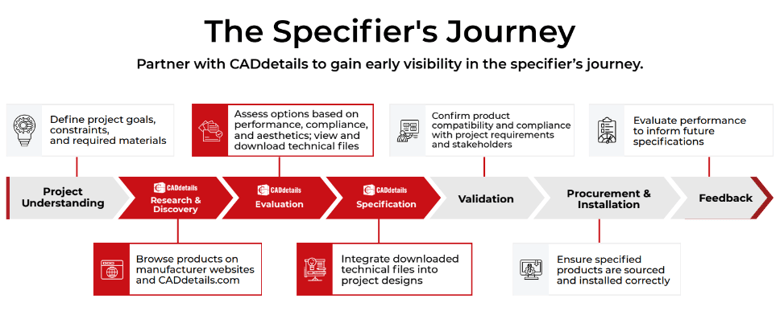
For over 25 years, CADdetails has delivered high-quality design content to the AEC community, while offering expanded marketing solutions like Design Hub and Ad Bundles to maximize specification opportunities and increase brand visibility among specifiers. CADdetails also offers robust analytics tools that let you track and measure AEC activity to strengthen your marketing and sales outreach.
 Pros:
Pros:
- Established industry leader with a large North American and global AEC audience
- Development and optimization services for CAD drawings, BIM models, 3D models, and outline specifications
- Advanced analytics dashboards with clear, measurable engagement insights
- Featured placement and advertising options to increase visibility and priority exposure
- Fully branded Design Hub, providing manufacturers with a dedicated, professional portal for hosting technical design content
- Dedicated project showcase section to highlight real-world applications
- Full integration with Prodify, the first-ever DAM (Digital Asset Management) and PIM (Product Information Management) platform built specifically for building product manufacturers (coming soon)
Cons:
- Premium visibility features require additional investment
- Success requires active participation—you’ll need to share files, engage with our team, and act on the analytics insights we provide. While we deliver high-quality intent signals, converting those insights into revenue depends on timely outreach and consistent follow-up from your sales team.
Pricing: Plan-based, learn more here.
Which Platform Is Best for You?
The reality is that no single platform captures 100% of specifier activity, which is why the most effective approach is often a multi-platform strategy.
Here are some strategic pairings to consider:
-
If you have physical samples: Material Bank + CADdetails
-
If you’re looking for design file support: CADdetails + BIMobject
-
If you’re looking for a technically robust, all-in-one platform (including BIM, CAD, 3D, specifications): CADdetails + BIMsmith
-
If you mostly have BIM content: BIM&CO + Bimstore
-
If you’re looking for strong integrations: BIMsmith + Lattira
-
If you want long-established platforms: ARCAT + CADdetails
-
If you want to try newer platforms: Lattira + Acelab Material Hub
-
If you want to focus on design inspiration: Modlar + Architizer
-
If you want strong brand recognition among North American AEC professionals: Sweets + CADdetails
The most important part of any platform is the team behind it. Look for a partner that helps you measure performance, addresses challenges like outdated CAD or BIM files, and gives you confidence that your investment is delivering real value.
At CADdetails, we strive to be more than a platform—we aim to be your partner in success.
Learn more here or book a demo with one of our experts.
Cover image by Maxwell Young on Unsplash